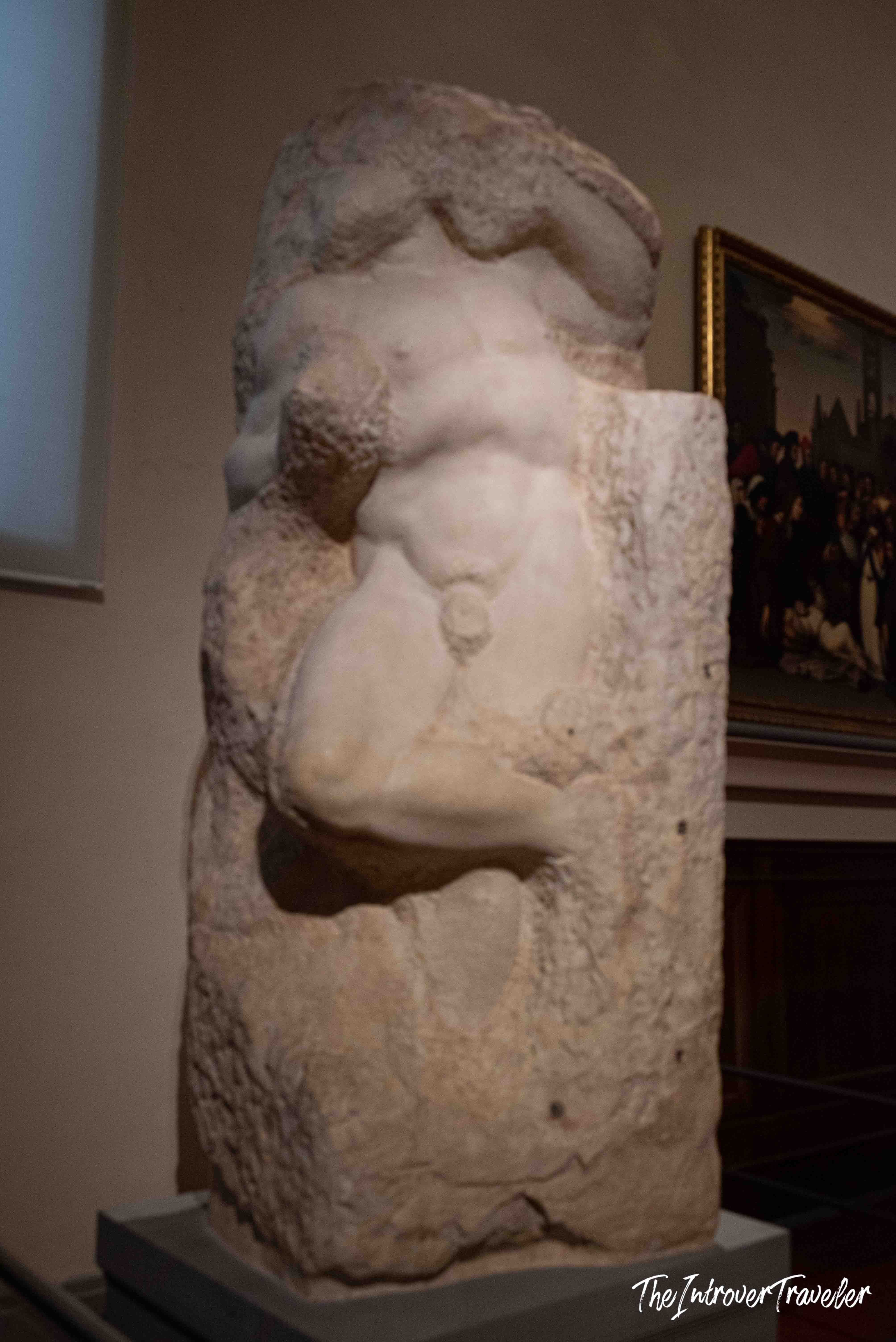
Michelangelo's Slaves (The Dying Slave & The Rebellious Slave)
Michelangelo
c. 1513–1516
Marble
229 cm (Dying), 215 cm (Rebellious)
Sculptures
Denon Wing, Ground Floor, Room 403 (Galerie Michel-Ange)
The Dying Slave and the Rebellious Slave are two unfinished marble sculptures carved by Michelangelo between 1513 and 1516. They were originally intended for the monumental tomb of Pope Julius II, which was planned to be an enormous freestanding structure with over forty life-size figures. Due to various complications, the tomb was drastically reduced in scale and these figures were never included in the final version.
The Dying Slave appears to drift into an almost sensual languor, his body relaxed and his head lolling as if surrendering to sleep or death. In contrast, the Rebellious Slave strains powerfully against his bonds, his muscular body twisting in a dynamic contrapposto that embodies raw defiance and unfinished struggle. The deliberate non-finito—the partly rough, unfinished marble—has been interpreted as a metaphor for the human soul struggling to free itself from the material world.
After passing through several collections, including that of the Connétable de Montmorency in France, the two Slaves were donated to King Henri II and eventually entered the French royal collections. They were transferred to the Louvre after the Revolution and are now displayed in the Galerie Michel-Ange, a gallery dedicated to Italian Renaissance sculpture.
