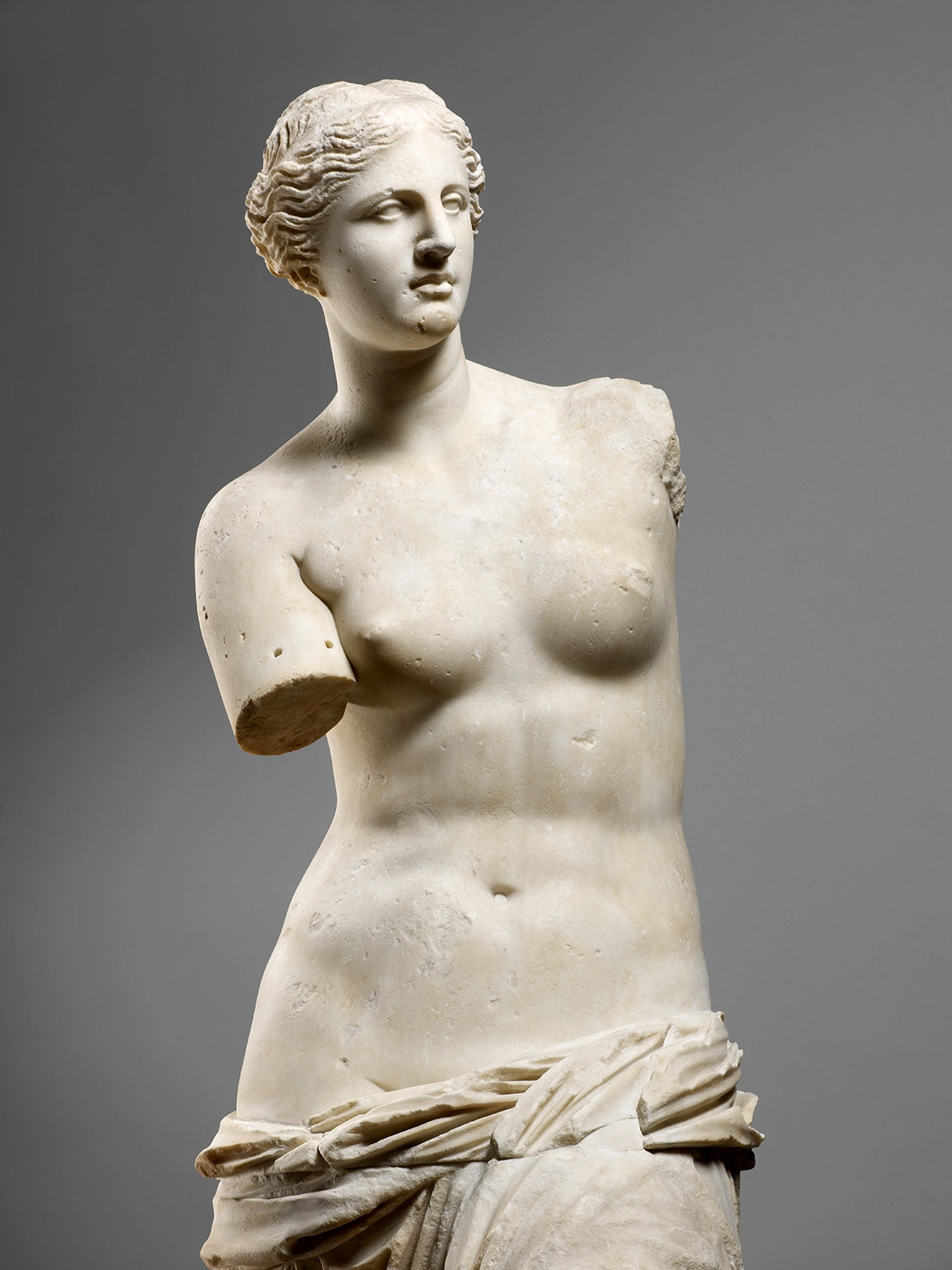
Venus de Milo
Unknown (attributed to Alexandros of Antioch)
c. 130–100 BC
Marble
204 cm (6 ft 8 in) height
Greek Antiquities
Sully Wing, Ground Floor, Room 346
Discovered in 1820 on the Greek island of Melos (modern Milos), this iconic Hellenistic sculpture was acquired by the French ambassador to the Ottoman Empire and presented to King Louis XVIII. The king donated it to the Louvre in 1821, where it has remained one of the most celebrated works in the entire collection.
The sculpture is widely identified as Aphrodite, the Greek goddess of love and beauty, though some scholars have suggested it may represent Amphitrite, the sea goddess who was particularly venerated on Melos. Standing over two meters tall, the statue is notable for its missing arms, which have never been recovered. Early proposals to restore the arms were abandoned in favor of preserving the work's evocative fragmentary state.
The Venus de Milo is considered a masterpiece of Hellenistic art, blending the idealized forms of the Classical period with the more naturalistic and dynamic qualities of the Hellenistic era. Together with the Mona Lisa and the Winged Victory of Samothrace, it forms the trio of the Louvre's most iconic treasures.